

In the first quarter of 2000, global debt was estimated by the Institute of International Finance and other leading macroeconomic databases at approximately US$80 trillion.
By the first quarter of 2026, that figure had risen to an extraordinary US$354 trillion.
Importantly, this officially recognised debt burden does not include the rapidly expanding unfunded liabilities of sovereign governments, particularly future pension, healthcare and social-security obligations. Nor does it fully capture the substantial off-balance-sheet liabilities embedded throughout the global financial system.
Over this 26-year period, officially recorded global debt has therefore increased at a compound annual growth rate of approximately 5.89%.
During the same period, the global debt-to-GDP ratio has risen from approximately 130% in 2000 to around 237% today.
However, even this is not the most alarming statistic.
The truly shocking figure is that global debt has expanded by approximately US$30 trillion in just the past 12 months, representing year-on-year growth of around 9.25%.
This uncontrolled acceleration in debt growth has occurred despite more than a quarter of a century of remarkable global economic development.
Since 2010 in particular, the world economy has been aggressively stimulated through unprecedented monetary expansion, quantitative easing and, in many major economies, interest rates at or close to zero for approximately seven years.
During this same period, we have witnessed the rapid emergence of artificial intelligence, substantial emerging-market expansion, enormous technological advancement and the extraordinary growth of China into the world’s second-largest economy and a dominant force on the global stage.
Yet despite all of this economic growth, innovation and productivity development, global debt has continued to expand at a materially faster rate than the underlying economy.
In other words, the world is creating progressively more debt for every additional unit of economic growth.
This is the defining structural problem.
The existing debt burden is now too large to be repaid through genuine economic growth, taxation or fiscal restraint alone. Governments and central banks will therefore be increasingly forced to manage these liabilities through financial repression, negative real interest rates, currency depreciation and continued monetary expansion.
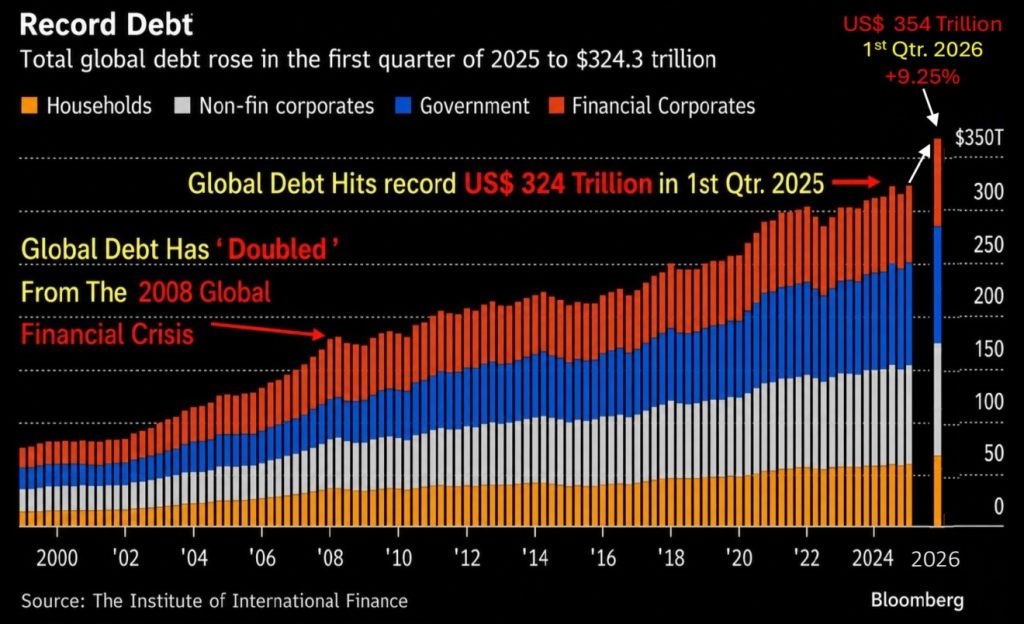
Let me try and make this easier to understand,
We have now reached an unsustainable mathematical juncture in global debt finance.
The United States is currently running a fiscal deficit of approximately 6% of GDP. Europe is running deficits of around 3.6% of GDP, with those deficits forecast to expand further as European governments commit to building a vast new military and defence complex it simply cannot afford.
And this is before the onset of a global recession, which, in my view, is now becoming uncomfortably close.
Deficit spending does not shrink during recessions. It explodes higher.
Tax revenues fall, unemployment rises, government support programmes expand, banking systems come under pressure and fiscal spending increases dramatically. The result is always the same: even more debt is required simply to prevent the economic system from contracting violently.
Governments cannot permit an outright sovereign debt default.
A major default would trigger a rapidly accelerating domino effect throughout the global financial system, threatening banking institutions, pension funds, sovereign bond markets and currencies. The consequences would be a deep global depression, extreme civil unrest and an even more dangerous escalation in geopolitical conflict as governments blame other countries for their mismanagement of the economic crisis.
The political decision has therefore already been made.
Governments will not repay this debt in sound sovereign currency. They will devalue it.
As sovereign debt is denominated in sovereign currencies, the most politically convenient solution is to reduce the real value of that debt by reducing the purchasing power of the currency itself.
This will be achieved through:
- Debt monetisation.
- Continued monetary expansion.
- Negative real interest rates.
- And what is politely referred to as financial repression.
Financial repression is simply a quaint term for a stealth tax on your savings, and your actual income and the real value of the capital you have spent a lifetime earning.
Any rhetoric from Kevin Warsh, as Chairman of the Federal Reserve, about aggressively fighting inflation, which in reality means defending the purchasing power of the currency, should therefore be treated with considerable scepticism and more accurately as outright nonsense of the highest order.
The mathematics simply ‘do not’ allow policymakers to maintain genuinely restrictive monetary conditions for any sustained period.
They must keep the debt system functioning.
And when the true rate of currency debasement becomes politically uncomfortable, they will simply continue adjusting, suppressing and manipulating the official inflation measures used to report it, as they have done over the last 30-years.
The official numbers may claim inflation is under control.
Your cost of living, your savings and the declining purchasing power of your currency will tell you otherwise.
The conclusion is unavoidable:
The global debt system cannot be resolved through repayment or debt serviceability. It can only be managed through monetary debasement.
Gold and precious metals will be heavily revalued higher in debased currencies, this debt crisis alone will absolutely assure metals will rise in value versus currencies.
Season buying trend and China buying spree next in Part 4, click here to read