
David’s Commentary – 10th September 2026
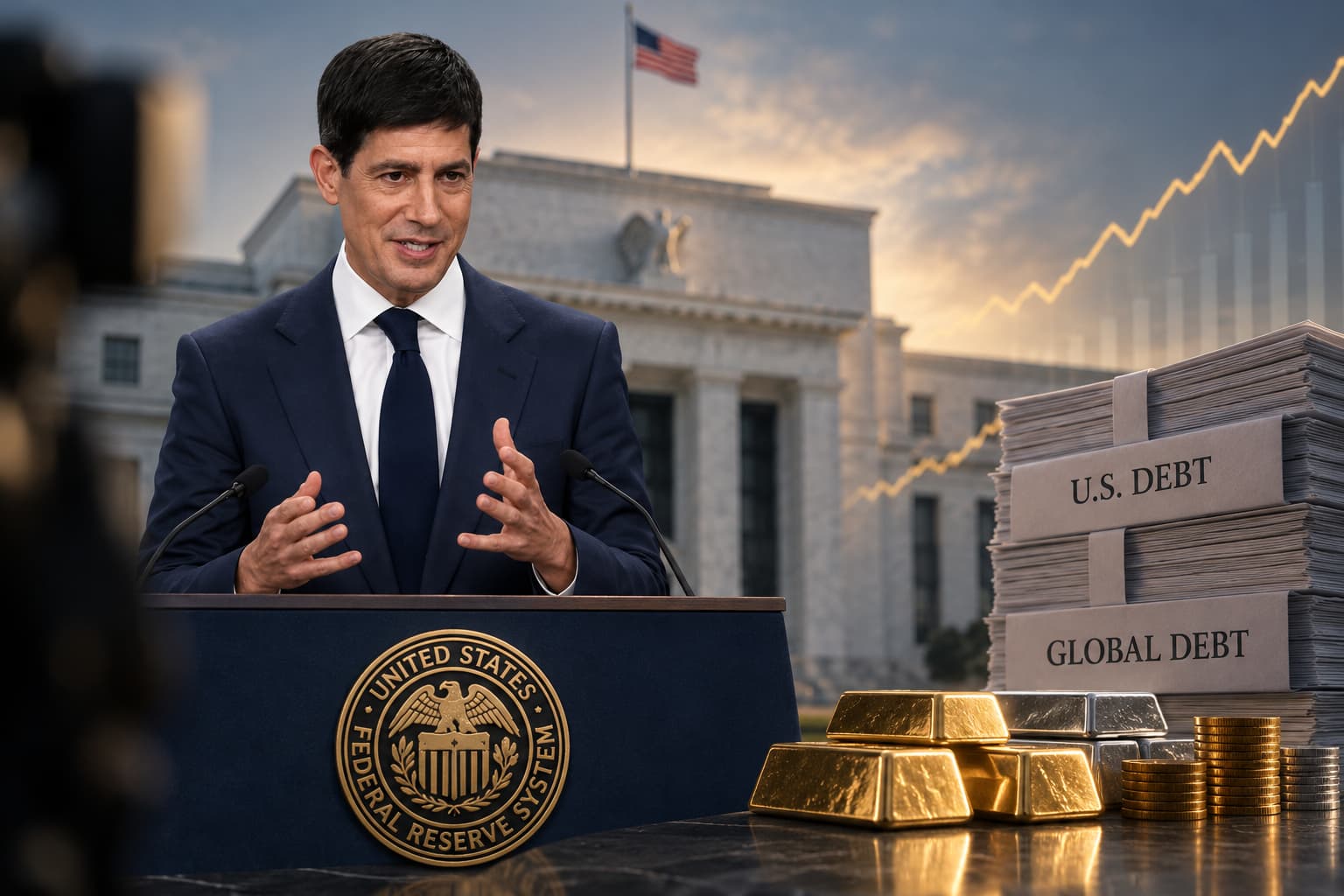
On Friday, 28th August ( 2 weeks ago now ), Kevin Warsh, the new Federal Reserve Chairman, certainly set the cat among the pigeons with his closely watched annual Jackson Hole speech.
Perhaps rather appropriately for Jackson Hole, the word “ hike ” featured prominently. His repeated references to hikes immediately changed the tone of the market. Warsh emphasised that inflation trends had not “ meaningfully improved ”, leaving the door very clearly open to further near-term interest-rate increases. More importantly, he warned that if inflation does not move towards the Federal Reserve’s objective at “ sufficient speed ”, then the central bank still “ has work to do. ”
Markets reacted almost immediately.
Precious metals, equities and cryptocurrencies were all sold aggressively, while longer-dated government bond yields moved sharply higher.
The problem, however , is the extraordinary backdrop against which the Federal Reserve is attempting to maintain this increasingly hawkish stance.
We are already operating within a real world of a global debt crisis , extending across sovereign governments, households and the corporate sector. Added to this is the rapidly expanding debt associated with the enormous capital expenditure requirements of the AI investment boom. These debt loads are already extremely large and, in many cases, continue to grow at an exponential rate.
Governments and central banks will, of course, continue to tell us that there is no systemic debt stress. In my view, that argument is becoming increasingly difficult to take seriously ( more accurately its nonsense ) when you simply look at the mathematics.
The US 10-year Treasury yield, for example, was approximately 4.67% before Warsh’s speech and is now trading around 4.85%.
That may not sound like an enormous move in isolation, but when applied across trillions of dollars of government borrowing and refinancing requirements, the implications become considerably more significant.
The United States still needs to issue somewhere around US$2 trillion, and potentially closer to US$2.35 trillion , of additional debt this year alone.
At the same time, approximately US$9 trillion to US$9.6 trillion of US government marketable debt is scheduled to mature over the coming 12 months and will need to be refinanced.
Much of that debt was originally issued at materially lower interest rates, with an average funding cost considerably below where now yields stand today. Consequently, an enormous portion of the US debt stock is gradually being refinanced at significantly higher rates.
We are therefore approaching a rather extraordinary contradiction.
The Federal Reserve is threatening higher interest rates in an economy and financial system carrying unprecedented levels of debt, while the US Treasury itself must simultaneously refinance and issue trillions of dollars of debt at increasingly punitive yields.
This is precisely why I continue to believe the present monetary cycle ultimately has very limited room to operate in the conventional manner. The mathematics of the debt burden will increasingly wholly dictate monetary policy, irrespective of what central banks may wish to communicate in the short term.
Yield Curve Control, as I have been writing about for the past three years, is ultimately where the West is heading ( Europe is in a worse position than the USA ). Financial repression and the monetisation of debt are unavoidable.
Against that backdrop, I continue to believe investors should use periods of volatility in precious metals to their advantage and build exposure when attractive opportunities present themselves. The broader revaluation of precious metals, in my view, has only just begun.
As we move toward the end of this decade, I believe the scale of the move higher across the precious-metals complex has the potential to shock the market significantly.