

David’s Commentary – 27 March | Sentiment on the Floor, Oversold Readings at Extremes, China Silver Imports Sky Rocket
Gold and Silver Markets at Extreme Oversold Levels
Market sentiment has remained deeply negative for several weeks, reaching levels last seen during the 8-year cycle low in 2022. Historically, such extreme pessimism often marks the formation of major price bottoms in precious metals markets.
This is typically where long-term market bases are built—confidence weakens, speculative positions are cleared, and conditions begin to form for the next upward trend in gold and silver prices.
From a technical standpoint, both gold and silver are now materially oversold, across daily and weekly timeframes. Key indicators such as the Relative Strength Index (RSI) and other momentum signals have entered historically stretched territory.
Gold, in particular, has returned to oversold levels last seen in October 2025, alongside the first meaningful test of the 40-week moving average in over two years—a critical long-term support level.
Market Sentiment Reversal Signals Potential Turning Point
Market psychology has shifted dramatically.
Earlier in the year, the prevailing narrative suggested metals could not decline. Today, sentiment has reversed, with growing consensus that the bull market may be over. Historically, such extreme shifts in sentiment often occur near major turning points in the gold and silver market cycle.
For long-term investors, this environment presents a different opportunity. Rather than attempting to time the exact bottom, the focus shifts toward accumulating physical gold and silver when valuations are attractive and sentiment is one-sided.
Current takeaway: periods of extreme pessimism have historically favoured long-term accumulation strategies.
China’s Silver Imports Surge as Physical Demand Strengthens
While Western sentiment weakens, physical demand from Asia—particularly China—is showing significant strength.
According to China customs data, February 2026 silver imports (≥ 99.99% purity) reached 206.76 metric tonnes, representing a 499% month-on-month increase and a remarkable 5,910% year-on-year surge.
This sharp increase highlights a growing imbalance in the global silver supply and demand dynamic.
Key Market Signals
- Weak sentiment in paper markets
- Extreme oversold technical conditions
- Strong physical silver demand from China and India
Historically, this combination has not marked the end of a bull market, but rather the early stages of the next price expansion phase.
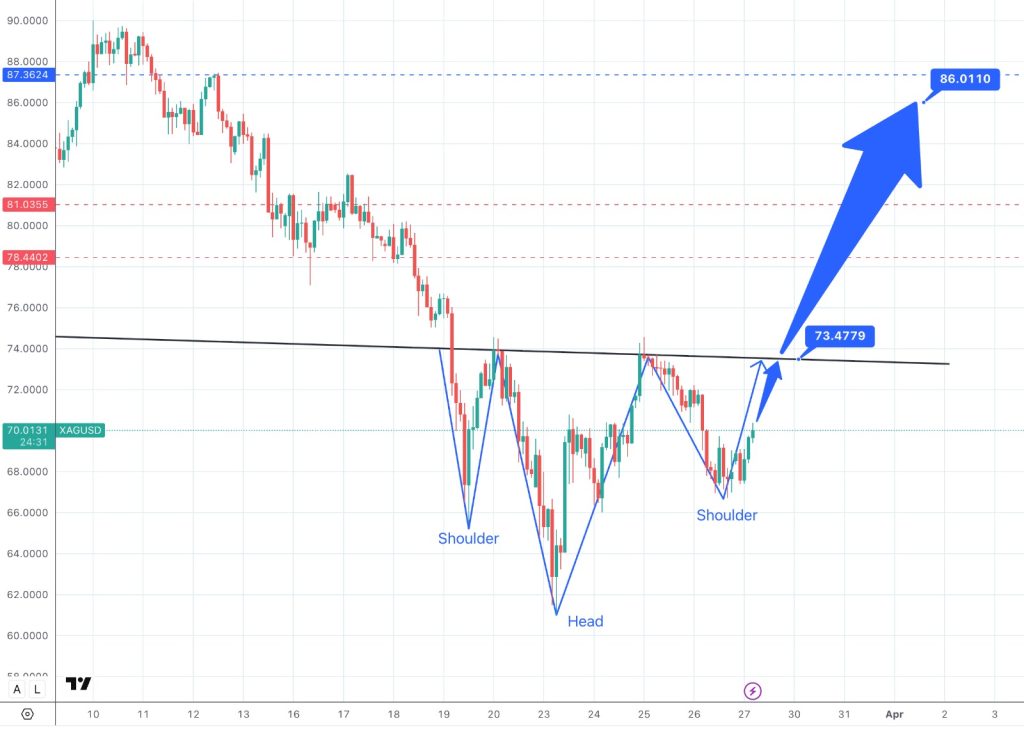
From a technical perspective, a potential reverse head-and-shoulders pattern is forming. A confirmed breakout, particularly a daily close above US$73.50, would strengthen the bullish outlook, with US$86 as a potential medium-term price target.
David’s Commentary – 29 March 2026 | Macro Watch
Monetary Intervention is Getting Close, Stagflation is Building, Yields are Rising
Stagflation Risks and Rising Bond Yields Signal Policy Pressure
The global macro environment is increasingly pointing toward a stagflationary backdrop— a combination of rising inflation and slowing economic growth.
Inflation pressures remain elevated due to energy prices, geopolitical tensions, and supply chain disruptions, while global growth momentum continues to weaken.
Bond markets are already reflecting this stress. Rising yields and expanding term premiums across sovereign debt markets indicate increasing financing risks and deteriorating fiscal conditions.
When bond yields rise in a slowing economy, the impact extends across financial markets, affecting:
- Credit markets
- Mortgage rates
- Equity valuations
- Corporate borrowing costs
Monetary Intervention May Be Approaching
Given these conditions, central bank intervention may become increasingly likely.
Historically, market stress follows a consistent pattern:
Liquidation → Funding Stress → Policy Response
As economic pressures build, policymakers may be forced to introduce liquidity measures to stabilise the system.
Current inflation is being driven by two primary forces:
1) Demand-Pull Inflation
Demand continues to exceed supply, amplified by structural shortages, fragile supply chains, and geopolitical disruption.
2) Cost-Push Inflation
Rising costs—energy, freight, raw materials, and wages—are being passed on to consumers. Elevated oil prices act as a system-wide inflation driver, impacting nearly all sectors.
Monetary Expansion and the Impact on Precious Metals
A third dynamic may emerge:
3) Monetary Inflation / Expansion
An expansion in money supply, leading to a decline in purchasing power.
With global debt levels at elevated levels and recession risks rising, central banks may be compelled to inject liquidity—historically a supportive factor for gold and silver prices.
While short-term volatility is expected, the broader macro backdrop remains supportive for precious metals investment.
The combination of:
- Rising yields
- Inflationary pressures
- Strong physical demand
- Weak market sentiment
creates conditions that have historically preceded upward moves in gold and silver markets.
Key Indicators to Watch
- Bond auctions and bid-to-cover ratios
- 10-year yields vs economic growth data
- Credit spreads and liquidity stress
- US Dollar (DXY) strength
- Oil prices and inflation trends
Conclusion
Markets often appear weakest just before major policy shifts.
With sentiment at extremes, physical demand rising, and macro pressures building, the current environment may represent a critical inflection point for gold and silver investors.